
Howdie doodie, and welcome to the first reading wrap up of 2026. I am very much in a reading kick at the moment, which I am fully embracing as the weather is shitty and the world is shitty and my mood is shitty. Bring on the books! *raises an imaginary sword*
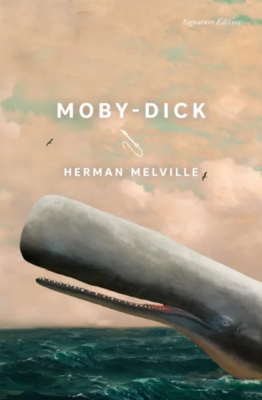
Moby-Dick by Herman Melville [did not finish 😬]
Okay, so I know I just exclaimed, “Bring on the books!” and raised my imaginary sword aloft, but I started the month with a big fat DNF.
The story of Moby-Dick is pretty well-known – a captain of a whaling ship has his leg bitten off by a big white whale and therefore seeks vengeance at any cost, chasing the beast across the tumultuous seas while putting his crew in constant danger in pursuit of his life’s ambition. It’s an epic tale, but perhaps a bit too epic for me. I put it down halfway through.
While I loved the relationship between Ishmael and Queequeg, as well as the descriptions of the crew on the Pequod, the story elements of the novel were often neglected in favour of endless chapters about the whaling industry, which quite frankly flittered out of my brain as soon as my eyes read the words.
I have tried telling myself that life is too short to read books I don’t enjoy, but I probably would enjoy Moby-Dick if I had the stamina for it. It’s very readable, and from the chapters I read I know it’s a brilliant feat of literature, but I haven’t read a ‘challenging’ book in quite some time and my analytical reading muscles are weak. While this DNF was painful as it highlighted how I have let some skills calcify, it has inspired me to return to academia – my goal is to be enrolled in a Master’s programme for literature in a year or two (funds permitting). Until then, I shall enjoy shorter, simpler books, such as…
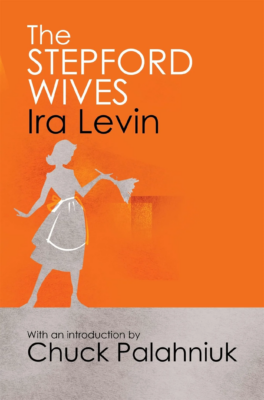
The Stepford Wives by Ira Levin
The Stepford Wives begins with the novella’s protagonist, Joanna, moving to the suburb of Stepford with her husband and two children, hoping for a wholesome life away from the city. Joanna has an uneasy relationship with her role as housewife; she loves her family and sees the necessity of staying at home, but she doesn’t want it to become her identity in any way. To retain some semblance of herself, Joanna sets up a dark room in the basement not long after the move to continue her freelance photography.
As the family settle into Stepford, Joanna notices that her community seems a little old-fashioned. While the husbands go to work, all of the wives keep house, and they don’t do a lot else. The women are all beautiful, immaculately dressed, cordial and have little time for anything other than housework and raising their children. Joanna finds some solace in her quirky neighbour, Bobbie, who’s endearingly messy and also thinks the Stepford wives are backward and boring, but is it just the culture of the ‘burbs? Or is there something more sinister at play?
I picked up The Stepford Wives immediately after giving up on Moby-Dick and proceeded to read the entire thing in one sitting. Man, I needed that. It was gloriously fast-paced, the characters were practically bouncing off the page at me and Levin was the master of building tension. Impeccable.
I wrote a more in-depth review of the novella in my last blog post, if you fancy reading that.
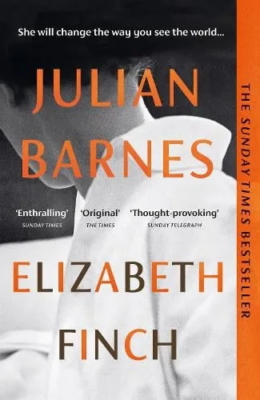
Elizabeth Finch by Julian Barnes
Elizabeth Finch is about a man’s platonic infatuation with his university professor. Neil sees Elizabeth Finch as a powerful enigma, and is fascinated by her views on the world, as well as her own lifelong adoration for Julian the Apostate. Elizabeth Finch has a considered answer for every question, and Neil wants to unravel the mysteries surrounding her – or does he? Perhaps he just thinks he does, and he’s actually more interested in preserving and delighting in her intangible pull…
I read Elizabeth Finch quickly, and while I enjoyed the writing style (this is my first Barnes), I didn’t enjoy much else about it. I struggled with Neil’s incomprehension of the fact that he was obsessed with a women he didn’t fancy, as well as his shock that she was smarter than him but that didn’t bother him at all! Woahhhh! Elizabeth Finch herself didn’t seem particularly interesting to me either, just a no-nonsense academic who was probably a bit lonely and had a penchant for cutting off her nose to spite her face, and…well, that’s it, there wasn’t much else to her. Was that the point? Was the concept of infatuation more important than the subject of the infatuation? I don’t know, and I don’t think Barnes gave me enough to care either way.
There was a distinct lack of humanity and warmth to this novel, and much of it felt like a display of intellect, especially the middle section. I have read many critics say this is Barnes’ least enjoyable novel, and although I may have chosen the wrong one to start off with, it’ll take a lot to persuade me to pick up anything else by him.
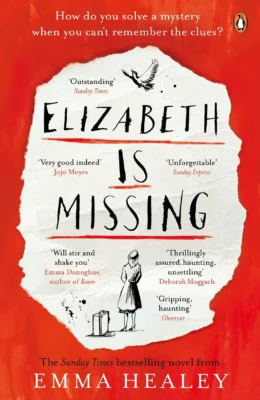
Elizabeth is Missing by Emma Healey
Maud is an elderly woman living alone who is rapidly losing her short-term memory. Day-to-day tasks and interactions are becoming more and more difficult, and she’s struggling to remember things that happened a few days, hours and even minutes before. But there are two things she does remember: her friend Elizabeth has gone missing, and as a child something bad happened to her sister. Will anyone believe her concerns and try to help her figure out these two mysteries? If not, will she be able to piece together what happened by herself?
This book had everything the last one didn’t – humanity, intrigue, warmth, enjoyable characters and a steady and interesting pace. I was fully invested from start to finish. I particularly loved the main character, Maud, who reminded me of the sweet old woman I volunteer to help (keep scrolling to the bottom of this post to find out more about her).
It was such a heart-breaking story and so well-written. I was initially sceptical as I doubted how a story about a character with memory loss could be portrayed, especially as it was written in first-person. but Healey gave just enough information to prolong the story and give you an idea about what Maud was confused about, while also confusing the reader.
While the ending was predictable, it was unavoidable given the set up. And it was still satisfying, just not as captivating as the rest of the book.
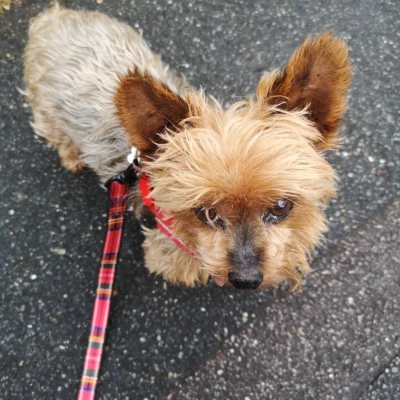
Like puppies? Keep reading!
In April I’m going to be running 10km in Brighton for a wonderful charity called the Cinnamon Trust.
The Cinnamon Trust is the national charity for older people, the terminally ill and their pets. They provide hands-on assistance to pet owners across the country when any aspect of the day-to-day care of their pets poses a problem, as well as the provision of lifelong care for pets who outlive their owners.
I currently volunteer with them, walking two Yorkshire Terriers, Millie and Ruby, for their elderly owner who is no longer able to.
If you’re able to donate a little something, please click the button below to be taken to my fundraising page. Thank you for reading!



Leave a Reply